.webp)
Table of Contents
Key takeaways
- AI success depends more on data readiness, governance, and observability than model choice, and Databricks reports 46% of proof-of-concepts never reach production.
- Clean, governed, proprietary datasets drive faster AI adoption across regulated sectors, including Mastercard credit applications, Rolls Royce maintenance prediction, and Walgreens drug distribution.
- Intercom scrapped its product roadmap within 72 hours of ChatGPT, then gains the ability to explore five product directions in the time one previously required.
- AI shifts teams from predictable multi-year planning toward shorter feedback loops, greater autonomy, and higher tolerance for ambiguity as technology changes faster than planning cycles.
- Trust in AI depends on design choices such as guardrails, oversight loops, and traceability, while Datadog sets a shipping threshold of more than 90% model accuracy.
- Vertical AI agents outperform general tools because adoption rises when they solve specific workflows deeply and work on top of existing platforms rather than replacing them.


When Bret Taylor told me the wave is always bigger than any company, it captured something I've been feeling while building at Pigment and talking to others doing the same. Success with AI is less about outpacing the technology and more about learning how to build while the ground is still moving.
Over the past few weeks, I’ve been interviewing AI leaders on how they’re doing just that, and you can listen to all the episodes here.
Each conversation was a chance to compare notes on what's actually working and where the hype breaks down.
- Bret Taylor has navigated three transformative waves from the inside – first at Google, Facebook, and Salesforce, and now at Sierra and OpenAI
- Des Traynor co-founded Fin AI and has transformed Intercom’s core business after scrapping the company’s entire product roadmap within 72 hours of the launch of ChatGPT
- Olivier Pomel has watched engineering teams at Datadog shift from building software to operating it at scale
- Mati Staniszewski has helped make AI voice a primary interface at ElevenLabs, changing the way people interact with software on a daily basis
- Naveen Zutshi has helped some of the world's largest enterprises move AI from pilot to production through his work at Databricks
The companies getting real results share the same patterns, and most have nothing to do with which models they're using. Here's what matters instead.
1. Data readiness matters most
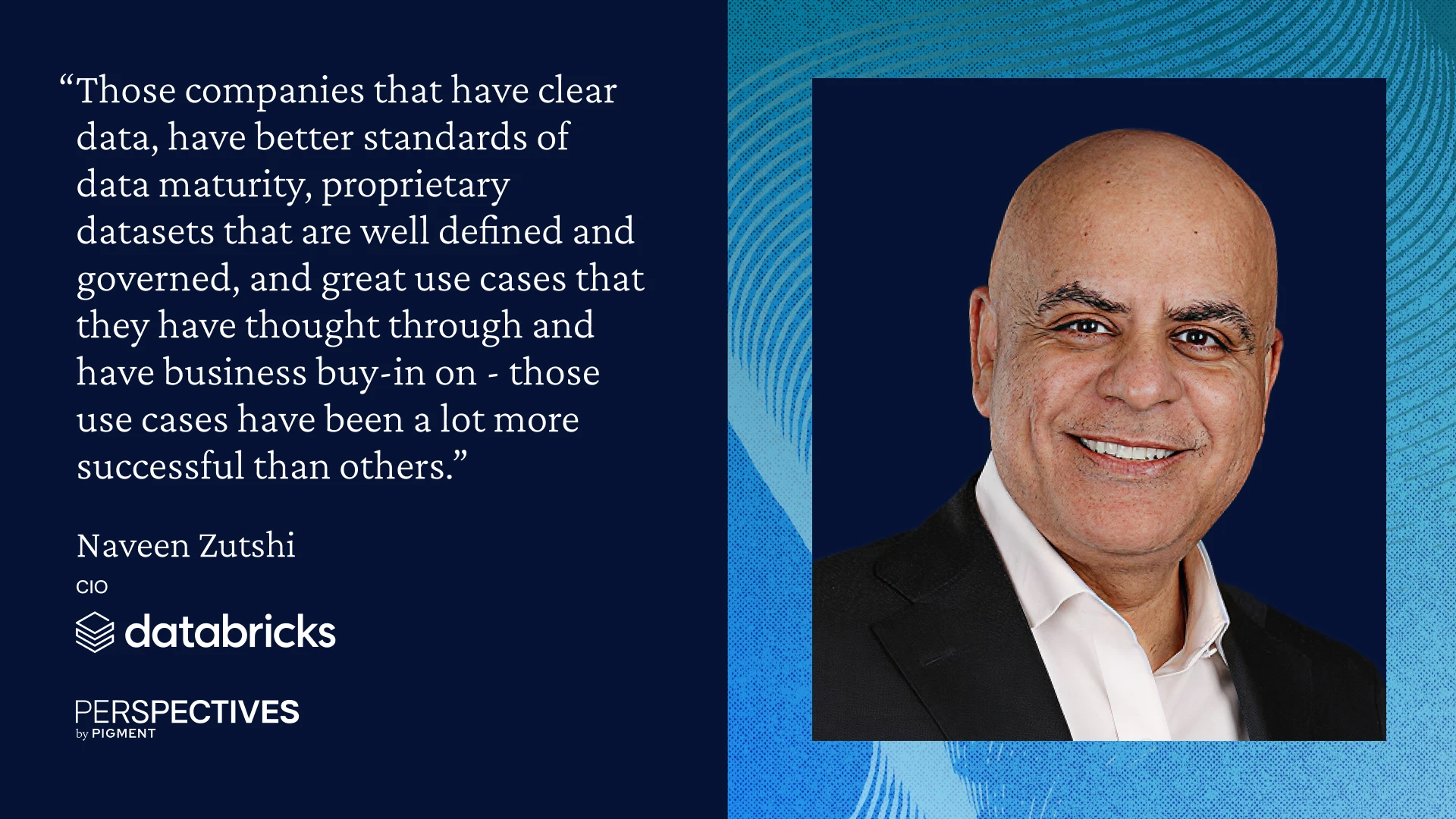
Early in our conversation, Databricks CIO Naveen Zutshi shared that 46% of AI proof-of-concepts are abandoned before they ever reach production. His reason why is data readiness.
Planning relies on pulling data from everywhere: CRM, ERP, HR systems, and spreadsheets that someone's been maintaining for years. When that data is messy or inconsistent, no amount of AI sophistication can fix it. You just get confident-sounding answers based on low-quality inputs.
When I asked Naveen which industries are moving fastest, he explained that speed doesn’t correlate with sector so much as it does with data maturity. He pointed to Mastercard processing credit applications, Rolls Royce predicting maintenance failures, and Walgreens optimizing drug distribution. These are three heavily regulated industries that most people assume move slowly. But they all had clean, governed, and proprietary datasets.
Olivier Pomel made the same point from an infrastructure perspective. At Datadog, he's watched applications explode in complexity as AI makes it possible to build in minutes what used to take months. "We are spending a lot less time building and a lot more time running applications," he told me. Observability – understanding how systems actually behave in production – has become non-negotiable.
What both Naveen and Olivier reinforced is something we've also seen at Pigment: you can't skip the foundation. The companies succeeding with AI are the ones that have invested in data readiness, governance, and visibility.
2. AI is throwing out existing modes of operation
After ChatGPT launched, Des Traynor explained how Intercom lost the ability to predict what was buildable. For 13 years, the team could spec a feature and know it was feasible. But, with advances in AI, that confidence vanished. Even simple ideas broke down when models hallucinated or when verification costs negated the automation benefit.
What Intercom gained in return was speed. Intercom can now explore five different product directions in the time it used to take to build one. AI also dramatically decreased the cost of exploration, which meant roadmaps could become almost interactive. Instead of debating which path to pursue, teams can now prototype multiple options side by side and evaluate them before committing. Although the comfort of predictability vanished, Intercom gained the ability to test assumptions faster than ever before.
.webp)
Mati Staniszewski, co-founder of ElevenLabs, originated the company as a collection of small, autonomous labs – voice lab, agents lab, music lab – where each team has full ownership. When I asked Mati how that doesn't turn into chaos, he said it only works if you hire people who are genuinely better than you at their domain. You have to be comfortable with far less visibility into what's happening day to day.
The insight isn't that there's one right structure, but that the structure itself has to change. Multi-year roadmaps assume predictability. Sequential approvals assume you can evaluate ideas upfront. Rigid hierarchies assume decisions flow cleanly from top to bottom. None of that works when you're building with technology that's evolving faster than your planning cycles. What does work is shorter feedback loops, greater autonomy, and higher tolerance for the discomforts of ambiguity.
3. Interfaces are being rewritten from scratch
Today, we spend all our time on screens and keyboards. As technology progresses, Mati sees voice becoming a (or the) primary interface.
But voice alone won’t be enough. The future is multimodal, with voice, vision, text, and reasoning working seamlessly together. Learning requires visual elements, and breaking through language barriers requires audio and visual models working in tandem.
Des described how conversational interfaces fundamentally change the customer experience. AI agents won't just solve problems reactively – they'll participate in the entire journey, showing products, explaining tradeoffs, and helping customers make decisions as part of the natural flow. To be successful, AI must adapt to humans, not the other way around.
Bret believes the next few years will define what the native interface for AI actually looks like. Not chatbots that mimic old patterns, but something genuinely new. It's about software that meets people where they naturally communicate.
4. Trust is a design problem, not a waiting game
Like humans, AI will never be perfect. But how close to perfect it needs to be varies by use case.
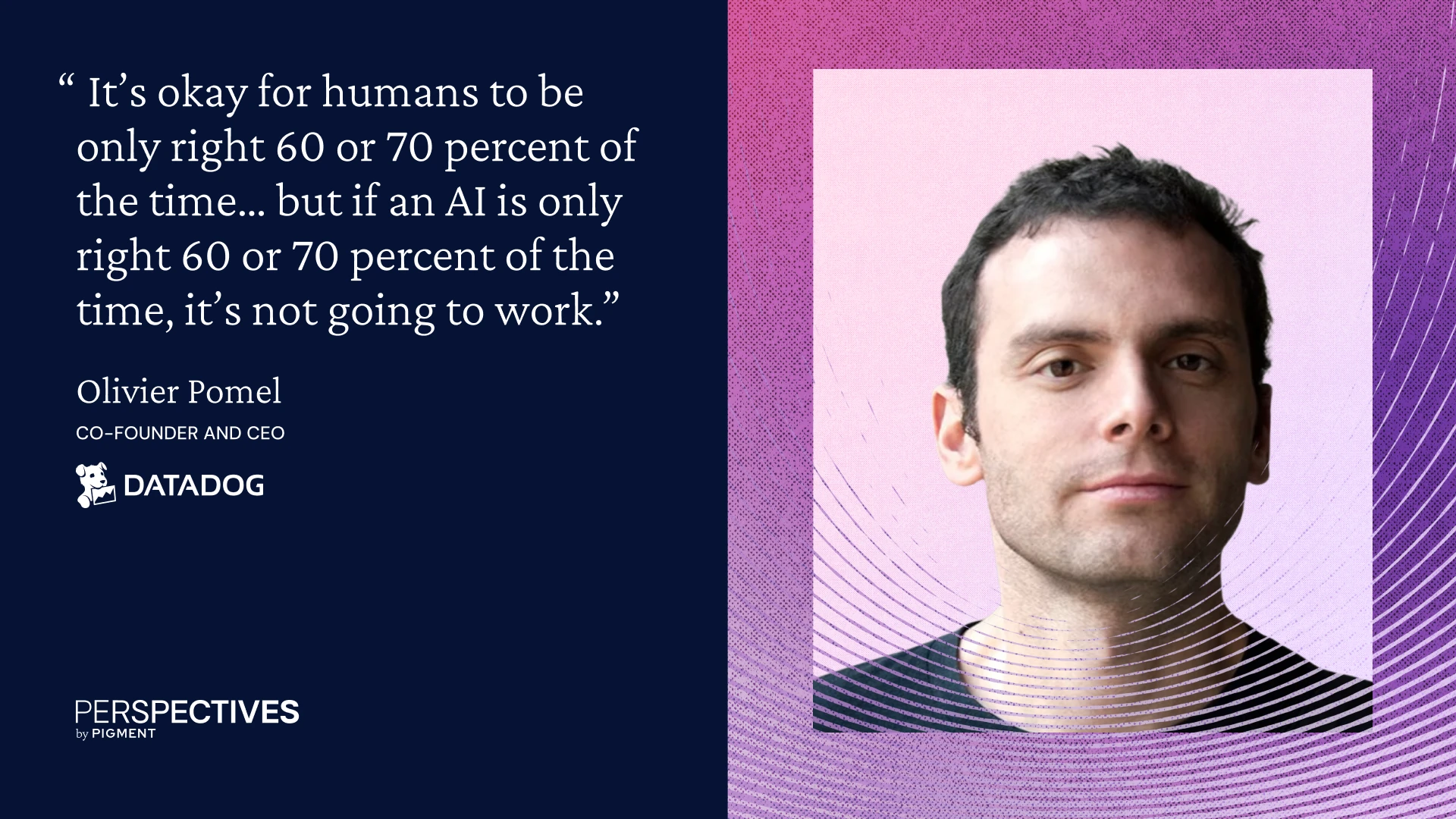
Olivier won't ship anything at Datadog unless the model is north of 90% accurate. As he puts it, “Humans being right 70% of the time is actually great. But if an AI is only right 60% or 70% of the time, it's not going to work."
At Pigment, we understand the need for tight accuracy margins. When an AI agent suggests a forecast adjustment, finance teams need to be able to trust it. If the accuracy isn't there, they'll stop using it altogether.
But waiting for 100% accuracy means never shipping at all. Bret's approach at Sierra is to design for imperfection. He encourages companies designing AI models to be honest about what agents can and can't do and to subsequently wrap models in guardrails. When oversight loops are built in, you’ll be ready to catch mistakes fast.
Mati built this safety net into ElevenLabs from day one. Every voice output includes traceability markers, and the platform blocks unauthorized voice cloning. But these precautions aren’t a blocker to moving forward. According to Mati, "Having guardrails from the start actually makes the entire process easier."
5. Vertical specialists outperform general tools
The most successful AI agents aren't trying to do everything at once. They're built for specific workflows with deep domain expertise.
Bret calls agents the atomic unit of AI, similar to the way websites defined the web era and apps defined mobile. But, unlike those predecessors, AI agents need vertical depth to be truly useful. A legal agent needs to understand compliance workflows. A support agent needs to know escalation paths. A planning agent needs to understand forecasting models and budget constraints.
Des proved this point at Intercom. Customers wanted Fin but wouldn't switch their entire help desk. Adoption only took off when Fin worked on top of their existing platforms rather than replacing them.
The pattern is consistent. Most companies succeed by solving specific problems exceptionally well, not by building general-purpose tools.
What leaders should actually do
Across all five conversations, several pieces of practical advice emerged for leaders navigating AI adoption.
- Get hands-on with the tools. You can't understand a new technology without using it yourself. Developing “AI intuition” involves playing and experimenting with AI models on your own time.
- Say yes to experimentation within guardrails. Overly cautious companies risk missing the window where experimentation turns into competitive advantage. AI leaders recommend saying yes more often to opportunities to test AI.
- Focus on clarity over control. Instead of trying to control every decision, provide clarity on vision and strategy. Define a framework for how ideas get evaluated, scaled, and integrated, then trust your teams to execute within it.
- Build short feedback loops. Without fast feedback, teams can convince themselves something is working long after the data says otherwise. Monthly contracts, weekly check-ins, and real-time metrics all help teams stay on track.
- Work openly with customers from day one. Building in the open matters more than competitive secrecy. Even if early versions are imperfect, the feedback loop accelerates learning.
- Embed technical talent everywhere. Engineers shouldn't only sit on product teams. Legal, operations, sales, and marketing can all benefit from technical talent that can build tools and automate workflows.
- Read widely and stay curious. AI represents the biggest transformation most of us will see in our careers. Subscribe to technical newsletters. Stay informed. Understanding where AI is heading matters just as much as understanding where it is today.
What it comes down to
None of these leaders had it figured out before they started. They began with decent data, stayed willing to rework the way they operate, built safety nets into their systems early, and focused on doing one thing exceptionally well. The gap between companies testing AI and companies using it to transform their inner workings and customers' realities is about being comfortable building while you're still learning. It isn’t always easy, but it's the way forward.
.png)
Frequently Asked Questions
Who is Perspectives for?
Perspectives is designed for business leaders who want a clearer understanding of how AI-powered systems are changing the way organizations operate. Whether you sit in product, operations, finance, data science, or the C-suite, this series offers practical insights into how top teams are prioritizing initiatives, managing risk, and building ecosystems that increase operational efficiency at scale.
What topics does Perspectives cover?
Perspectives explores how today’s most influential founders and operators are advancing artificial intelligence across modern organizations. Episodes highlight how top leaders build scalable AI capabilities, refine AI models, and develop AI applications that support evolving business objectives. You’ll hear candid stories about using generative AI to optimize business processes, improve customer satisfaction, and unlock meaningful competitive advantage.
What is Perspectives?
Perspectives is a tech leaders podcast and interview series featuring some of the biggest names in tech. We unite leaders in AI and business to discuss spanning enterprise AI transformation, governance, and product leadership.
What does it take to be an AI leader?
We consider AI leaders those who use their voice to push the industry toward safer, more transparent AI systems, advocate for strong governance, and drive practical innovation that helps organizations solve meaningful problems. If you’re an AI leader at your organization, get in touch. We’d love to hear from you.