.jpeg)
Table of Contents
Key takeaways
- The recession playbook centers on scenario planning across best-case, worst-case, and momentum-case futures, with explicit triggers such as declining orders, longer sales cycles, or rising defaults.
- FP&A teams increasingly integrate cash flow forecasting into P&L outlooks and scenario models, while AI and machine learning strengthen predictive capability in volatile conditions.
- Rolling forecasts that update monthly or quarterly replace static annual budgets and support faster reforecasting, continuous planning, and quicker responses during a crisis.
- Recession response follows three priorities: preserve cash immediately, innovate to win spending from reluctant customers, and then execute bold strategic moves for post-recession advantage.
- PwC reports that focused investment companies average 18% higher EBITDA margins and 10% higher enterprise-value-to-revenue multiples than industry peers.
- Bain identifies three common downturn traps: aggressive across-the-board cost cutting, straying too far from the core in search of growth, and acting too late.


When was the last time you felt the ground beneath you shifting?
We know from history that companies make more dramatic gains and losses during downturns than they ever do during stable periods. But by the time the downturn is obvious to everyone, the window for strategic positioning has generally narrowed.
FP&A leaders who successfully steer their companies through tough transitions do so by building their recession playbook ahead of time. This is just as much about planning for multiple futures as it is knowing which levers to pull and establishing the triggers that will tell you when to act.
This article will help you do all three.
Start with scenario planning (and set triggers)
Scenario planning requires you to be ready for multiple versions of the future, including a best case, worst case, and momentum case. It involves envisioning different economic possibilities and articulating the specific decisions your team would need to make if each one unfolds.
Start with a realistic assessment of where your company stands relative to competitors, which accounts for your strategic position, your financial strengths, and your flexibility. This assessment will dictate whether you're better positioned to play defense (by paring back noncore products and focusing on core strengths) or to play offense (by pushing aggressively for market share).
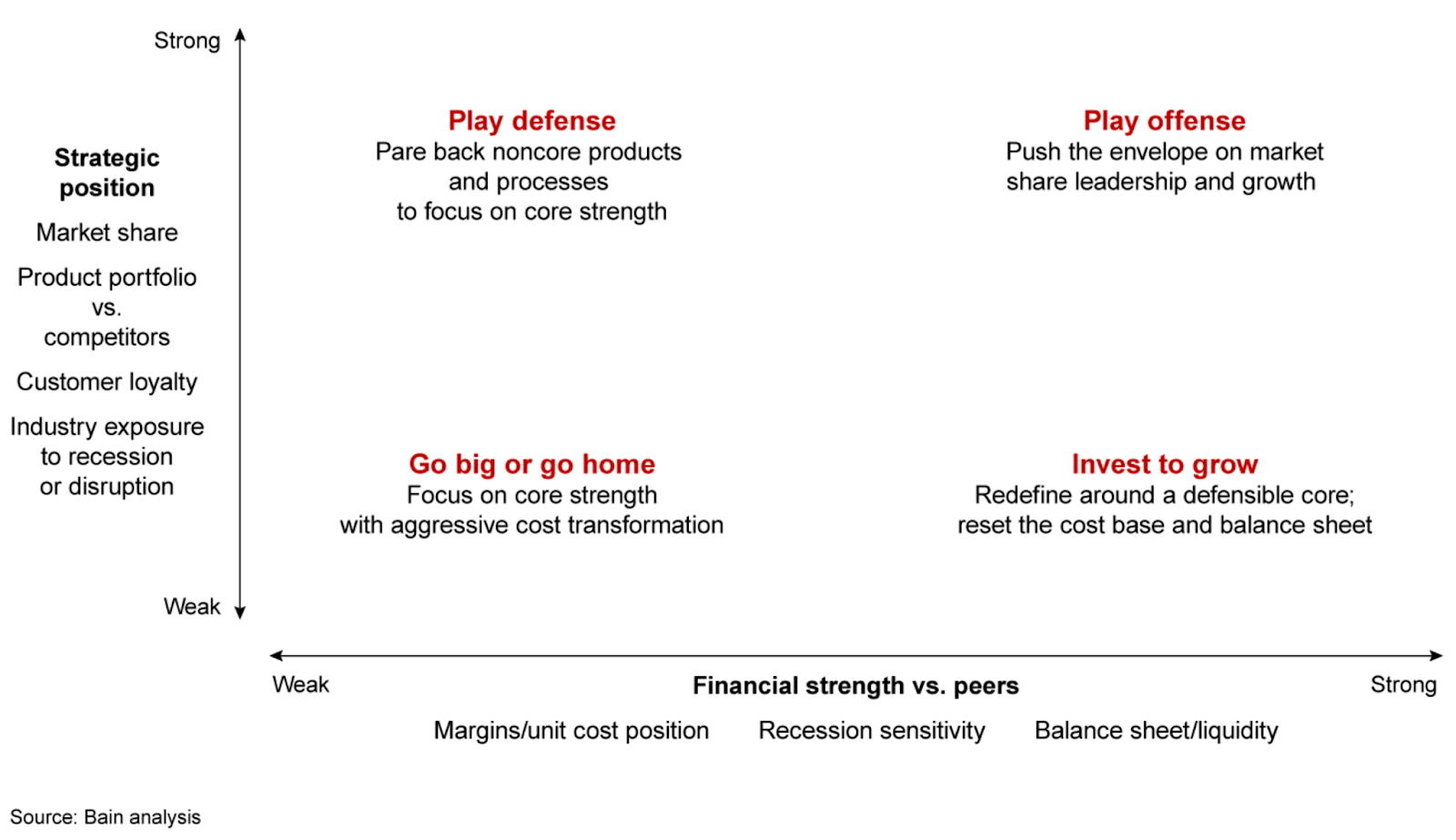
The next step is to establish explicit triggers, such as declining order volumes, elongating sales cycles, or rising default rates. Consider which signals could indicate you're entering Scenario A versus Scenario B. Then, map out ready-to-follow steps for each. When a trigger hits, you execute. You won’t need to call an emergency meeting to figure out what to do, because you’ll already know.
This kind of planning also requires you to build high-resolution visibility into your spending and key operational levers. You need to know exactly how commercial decisions, procurement changes, and supply chain shifts will impact working capital and free cash flow. To do this, more and more finance teams are integrating cash flow forecasting directly into their P&L outlooks and scenario models, and they're using AI and machine learning to create more robust predictive capabilities in this volatile environment.
Build quick re-forecasts into your strategy
One of the biggest competitive advantages you can have in a crisis is the speed at which you can reforecast. Shifting to rolling forecasts – where projections update monthly or quarterly – can help your company improve its visibility into the future. Achieving more dynamic forecasting capabilities can set the stage for faster responses when the economy throws a challenge your way.
This means moving away from static annual budgets and toward continuous planning. It also means building the muscle to rapidly improve costs while establishing capabilities for recurring cost control. The goal is to avoid reactionary responses, like scrambling to make sense of new macroeconomic realities after they've already hit.
Prioritize your next moves
When thinking about recession response, it helps to break the challenge into phases, each with its own objectives and levers. LEK has three phases to consider, in order of priority:
1. Immediately focus on preserving cash
In a recession, the primary goal is near-term survival. That means minimizing operating losses, controlling working capital, deferring projects that require major investments, and making full use of existing credit. It also requires establishing cash management best practices before you need them, like consistent financial reporting cadences.
2. Innovate to win business from reluctant customers
In the short term, your job is to maximize sales and margins by persuading reluctant customers to spend money with you. This requires understanding how customer needs and behaviors are shifting, rapidly prototyping new offers or messaging, and quickly optimizing the tactics that work.
You're adjusting a limited set of levers – like marketing, pricing, promotion – but you're doing it with precision and speed. This is where customer insight becomes currency.
3. Execute bold strategic moves
Take a fresh, critical look at your strategic options, and consider bold moves that will create meaningful competitive advantage in the post-recession marketplace. Companies that achieve significant gains or losses during a recession almost always carry those legacies through the subsequent boom cycle. Often, companies come out on top by finding opportunities in the worst of times.
Remember that cost management is not just about cutting
Controlling expenses is often the only reliable lever a CEO or CFO can pull to meet short-term profit targets in uncertain times.
Instead of playing pure defense, the best approach is often to see costs as investments in the business. According to PwC, companies practicing "focused investment" – where every dollar deployed works for the strategy and growth agenda – averaged 18% higher EBITDA margins and 10% higher enterprise-value-to-revenue multiples compared to industry peers.
That means restructuring costs before the downturn hits, or trimming the fat while preserving vital muscle and arteries. Don't fall into the trap of aggressively slashing R&D budgets or eliminating the marketing investments you need to grow. Instead, justify each cost. New York City recently did this by mandating that each city agency appoint a Chief Savings Officer to review operations, identify high-performing programs, and eliminate waste. That same principle applies in the private sector. Cost management involves understanding what drives value, doubling down on what works, and systematically cutting what doesn't.
Another way to improve cost management is to scale AI in FP&A. Intelligent automation can improve cost visibility and free up vital human resources during an economic downturn. When finance teams can automate recurring tasks like data consolidation, variance reporting, and forecasting updates, they open capacity to focus on higher-value work. Automation also reduces the risk of manual errors during high-pressure periods when mistakes can be costly.
Communicate clearly with leadership
CEOs don’t want more data. They want clearer options, with explicit upsides and downsides for each path forward. Your assessment of the company's competitive position should guide the sequencing and prioritization of which recessionary levers to pull.
Help your leadership team understand whether the moment calls for playing defense or offense. Give them the visibility they need to navigate competing capital needs like operational resiliency, strategic investments, and ESG commitments. If you can take fiscal complexity and use it to help drive someone’s “aha moment,” you’re well on your way to giving leadership confidence in their decisions.
Look for opportunity in crisis
It might not feel or look like it to the naked eye, but recessions can surface opportunity.
Recessions bring periods of innovation and transformation where competitive landscapes are completely altered. Customers may permanently redefine their value equations, including where and when they shop, how often, at what price point. Meanwhile, distributors and suppliers become willing to modify existing practices and terms.
For the prepared, this spells opportunity. Strategic options that weren't viable even a year ago may now be on the table. An economic slowdown can be the perfect time to optimize your business portfolio for sustained growth. When valuations are impacted, it can drive down the price of attractive acquisition targets. To create value in these circumstances, you’ll need a mindset of continuous business transformation.
Here are some bold moves to consider when planning for a recession:
- Increase share and scale by acquiring or merging with a major competitor
- Diversify within the value chain by buying into adjacent sectors that complement your core
- Expand geographically into mature markets where you’ve identified pockets of unmet demand
- Re-engineer your supply chain to systemically reduce risk and increase flexibility
- Enhance distribution channels to reach customers in new ways
Playing offense also means selectively reinvesting in sustained customer relationship building. If you invest more in customer engagement than a key competitor, you stand to maintain existing customers and earn new ones while other businesses are pulling back.
Avoid common traps
Bain reports three traps that are particularly common during economic downturns:
- The “burn the furniture” approach: Aggressive, across-the-board cost cutting that destroys future growth potential
- The “try everything” approach: Straying far from your core in a desperate bid for growth
- Waiting too long: Being late to act, then scrambling to catch up
Reactive cost cutting won't put you ahead of the curve, and it can damage long-term growth. The same is true of trying too many things at once, or waiting too long to act. What does work is thoughtful preparation and communication, paired with the conviction to act according to the plan.
Move forward with intention and conviction
You’ll need to pull specific ropes to right the ship during a recession, like preserving cash and innovating to win over reluctant customers. With the right ones in hand, you can even pull off bold strategic moves. All it requires is building your playbook ahead of time, so you can move quickly and decisively.
One of the best perspectives a company can take is to focus on opportunity where others see only risk.
At Pigment, we see this playing out in real time. Finance teams using our platform build scenario models faster, reforecast with precision, and give leadership the clarity they need to follow their instincts for survival and growth.
Pigment helps finance teams spin detailed scenario models in minutes and reforecast as conditions change. See how every decision impacts cash flow and working capital. When the ground shifts, you'll know what to do.
.webp)