.jpeg)
Table of Contents
Key takeaways
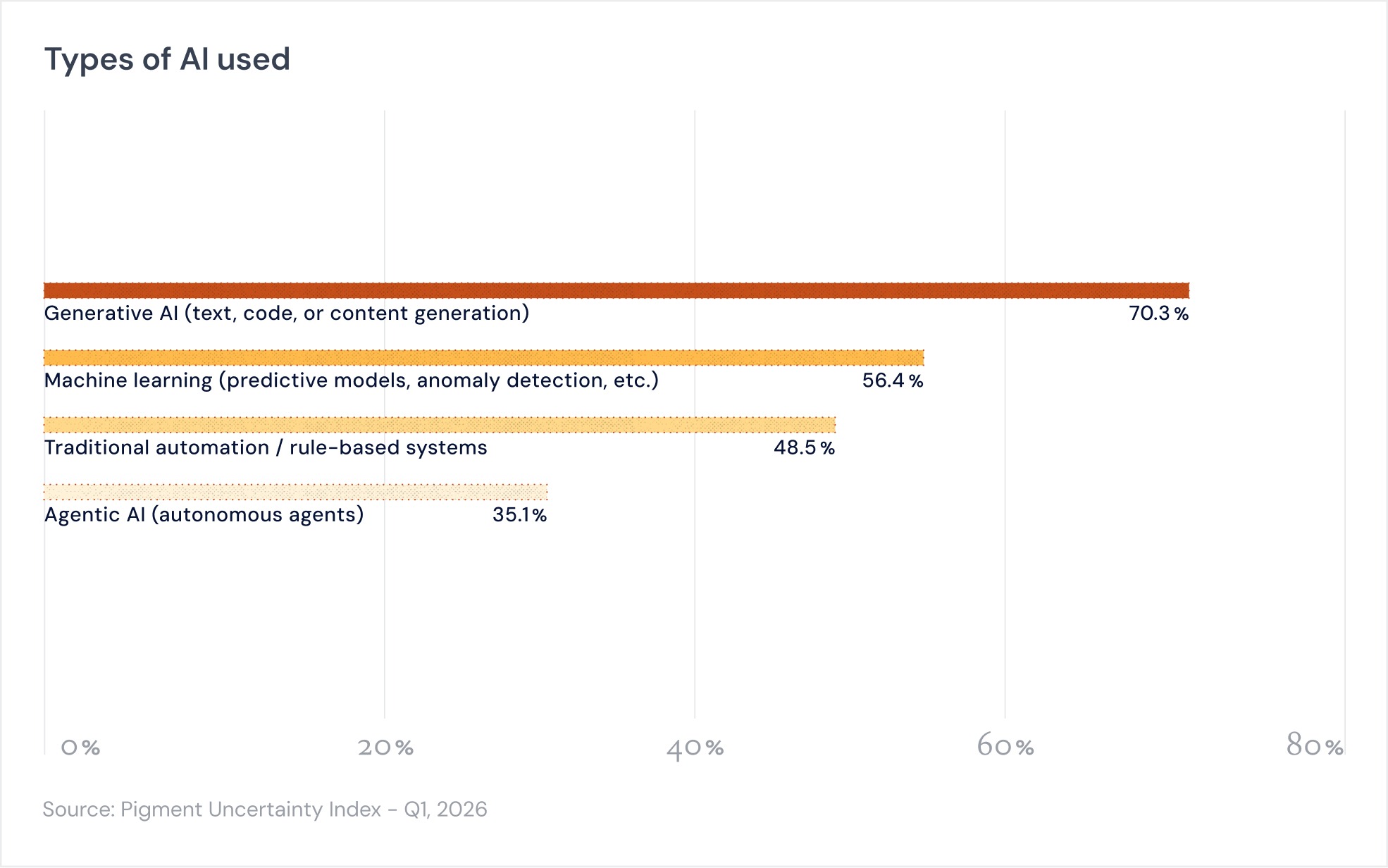
- Generative AI is the most widely used AI in finance at 70.3%, ahead of machine learning at 56.4%, traditional automation at 48.5%, and agentic AI at 35.1%.
- GenAI adoption in finance functions reaches 72% in small and mid-sized organizations and 65% in enterprises, compared with 46% to 49% and 54% for traditional automation.
- GenAI gains traction in finance because natural language lets teams draft formulas, summarize variances, write VBA scripts, and create reports without new systems or IT support.
- Lower entry costs also accelerate adoption, with entry-level GenAI subscriptions often priced at $20 to $30 and cloud services reducing infrastructure requirements.
- Agentic AI changes finance workflows by detecting variances, pulling context, comparing thresholds, drafting summaries, routing reviews, and recommending next steps without manual progression.
- Agentic AI remains earlier-stage in finance, with 29% of enterprises using it and other organization sizes reporting 35% to 37%, while governance maturity remains limited.


According to the Pigment Uncertainty Index, generative AI (GenAI) is now used in more finance functions than machine learning or traditional, rule-based automation.
Automation in finance has long needed structured workflows, technical support, and clear guidelines. GenAI lifts some of these barriers. Finance teams can now ask questions, draft reports, summarize variances, clarify messy text, and create spreadsheet formulas using natural language, making experimentation much easier.
That doesn’t mean traditional automation is going away. If anything, GenAI may make automation easier to set up, easier to scale, and easier for finance teams to use without waiting on technical specialists. The more important question is what happens after the first wave of adoption. If GenAI makes AI more accessible, agentic AI is what makes it fully operational.
The Pigment Uncertainty Index covers financial performance, AI adoption, planning confidence, and forecasting practices across 2,000 finance leaders in the US, UK, France, and Germany.
Download the full Q1 2026 report ->
GenAI has earned its adoption by being simple to use
Ask an FP&A practitioner why they’ve chosen to use GenAI, and they’ll likely tell you it’s not about replacing existing automation programs. Instead, they’re being driven by ease of use. What’s revolutionary about this technology is that an FP&A practitioner can ask a GenAI tool like ChatGPT or Claude to draft a formula, summarize variances, write a VBA script, convert tables into commentary, or create a board update, all without having to overcome the hurdles of learning a new system or asking their IT team for help.
Affordability is also at play; JPMorgan Chase Institute found that use of GenAI among small businesses grew as entry costs fell and as cloud services reduced infrastructure requirements. While natural language interfaces removed technical barriers, entry-level subscriptions (often priced at $20 to $30) made AI accessible even for those who could not afford more complex systems.
Using traditional automation requires thinking ahead to create pre-set rules. Meanwhile, GenAI adapts to user intent. Finance leaders can define their needs, refine outputs, and unlock value before workflows are fully standardized. That’s a useful solution for teams that are often still working with spreadsheets.
In small and mid-sized organizations, GenAI adoption in finance functions sits at 72%, while traditional or rule-based automation is lower, often in the 46% to 49% range. Even at the enterprise level, where legacy automation investments run deeper, GenAI adoption is 65% compared with 54% for traditional automation.
Generative intelligence is replacing traditional automation by democratizing it
When talking about what’s next in finance, it’s helpful to first compare traditional automation to generative intelligence. However, GenAI should not be viewed as the opposite of traditional automation, but as an enabler that helps teams create and extend their automation capabilities.
According to Pigment’s Uncertainty Index, the top AI use cases in finance include automating repetitive tasks, generating summaries and reports, and forecasting. GenAI helps with the work that floods finance processes every day by pulling information together, checking assumptions, and turning business data into actionable insights.
GenAI adoption has spread as quickly as it has because teams do not need to redesign finance processes to gain value. This benefit grows when AI models have access to real-time, governed data and repeatable workflows.
Agentic AI is where finance workflows start to change
GenAI is effective at responding to specific requests, but it can’t always take the next step without waiting for user input. This is where agentic AI fills the gap. AI agents are proactive, autonomous systems that operate continuously in the background, improving processes and supporting financial teams.
In practice, the difference looks like this: If you tell a GenAI tool to compose a variance summary, it can do so with the right input. But an agentic workflow can detect the variance, pull related context, compare it to thresholds, draft the summary, route it for review, and recommend where to focus next. Unlike with GenAI, AI agents ensure a human doesn’t have to move the workflow through granular steps manually.
The Uncertainty Index data shows agentic AI is still in the early stages of adoption, with less than a third of enterprises (29%) currently employing it. All other organization sizes report higher figures, between 35% and 37%, but this still does not supersede the adoption rate of GenAI. This is likely because, to succeed, agentic AI needs more access, context, permissions, and business logic than Gen AI. On the whole, agentic tools require a deeper level of both integration and trust.
This is especially the case in finance, where automation must be controlled, explainable, and auditable. It’s why workflow-style automations have historically been an easier sell for finance teams than highly autonomous agents. Deloitte’s 2026 State of AI report makes a similar point from a governance standpoint: only one in five companies has a mature governance model for autonomous AI agents, even as agentic AI usage is expected to rise sharply over the next two years.
The next leap depends on context, tools, and governance
Finance teams need more than GenAI adoption or new AI purchases to achieve agentic transformation. They must give agents the context to act, connect that context to tools and data, and decide when human input is needed.
Context
Context is what tells an agent how to act. Finance teams set the objective, the constraints, the data the agent can draw on, the output they expect, and the conditions for stopping or escalating. With that in place, the agent can carry out multi-step workflows while the team focuses on interpretation and strategy.
Tools
Agents are more useful when they can access systems, models, and data sources. Tools, information retrieval, memory, and guardrails are key in finance. Without these, an agent may describe what should happen, but cannot dependably execute or check it.
Governance
The more autonomous the workflow, the more important oversight becomes. Finance teams need to define which actions can be automated, which require approval, which data sources are trusted, and how outputs should be logged. AI can generate forecasts, identify key business drivers, and rapidly model complex scenarios, but the value depends on applying those capabilities inside a trusted planning environment.
What should finance teams do next?
GenAI, traditional automation, and agentic AI all have their own benefits. To operationalize agentic AI beyond initial pilots, you’ll need to understand where it belongs in the finance operating model.
A practical starting point is to separate one-off assistance from repeatable work.
- Traditional automation is useful when the process is structured and rule-based.
- GenAI is useful for drafting, summarizing, explaining, and creating first-pass outputs.
- Agentic workflows become useful when the work is recurring, multi-step, and dependent on changing context.
Finance teams can start by looking at where GenAI is already being used. Which prompts are repeated every week? Which spreadsheet fixes keep coming back? Which commentary drafts always follow the same pattern? Which reports require the same inputs, checks, and explanations? These are strong candidates for structured, agentic workflows.
That’s the difference between asking GenAI for help and assigning an agent a mission. Pigment’s Analyst Agent, for example, can run a user-defined mission that specifies the task, data scope, instructions, output format, and assumptions. In a variance analysis workflow, that means comparing actuals against budget, flagging material variances, generating explanations, and producing a structured report for review.
Operationalize the multi-step workflows GenAI can't handle with agentic AI
Finance teams are already using AI to automate repetitive tasks, generate summaries and reports, and improve forecasting. But modeling assistance scored lowest across our data sample. We attribute that to two factors: 1) growing-but-new adoption of agentic AI and 2) the fact that it’s difficult to get right.
Financial modeling requires combining structured logic and flexible interpretation. For a modeler agent to work, the AI agent needs to understand the business context, translate that context into formulas and dimensions, preserve dependencies, and make changes without breaking the planning environment.
Pigment’s Modeler Agent is built to take care of this need. Powered by intent modeling, it allows teams to describe the outcome they want in natural language and then translates that intent into governed, production-ready models and applications. Unlike generic AI tools, it is purpose-built for enterprise planning, with context for metrics, formulas, data relationships, and governance constraints.
The Modeler Agent helps finance teams extend models and update assumptions as the business changes. Finance teams can ask questions about formulas and dependencies and maintain auditable change histories without relying on weeks or months of manual reconfiguration.
Start your finance team’s next chapter with Pigment’s Modeler Agent
Meet the Modeler Agent →
The full dataset behind these findings is available in Pigment’s Q1 2026 Pigment Uncertainty Index.