.webp)
Table of Contents
Key takeaways
- Building AI agents in-house often looks cost-effective at the proof-of-concept stage, but hidden production requirements make enterprise-grade deployment much harder than expected.
- The article identifies orchestration, monitoring, debugging, system integrations, regression testing, evaluation, and behavior drift detection as major hidden costs of in-house agent development.
- AI development differs fundamentally from normal product development, and rapidly changing agentic AI standards such as agent-to-agent workflows, MCP, and skills keep internal stacks in constant flux.
- Only about 31% of finance teams plan to develop agents in-house, while most activate agentic AI through existing platforms, new software, or external partners.
- Vendor-built solutions provide ready-to-use capabilities, frequent updates, embedded compliance controls, and integrations with systems such as ERPs, CRMs, data lakes, BI tools, ChatGPT, and Claude.
- For finance teams seeking quick ROI, partnering with experienced vendors can raise the odds of success by 5% or more and enables deployment in weeks rather than months or years.


As agentic AI capabilities evolve, many teams are wondering whether it’s best to build their own agents in-house, or to buy.
On the face of it, the prospect of building AI agents in-house sounds appealing: it allows for more control, custom logic, and may feel like a most cost-effective approach. And because of how LLM-based AI works, you might find it quite easy to get a proof-of-concept up and running that feels like it’s nearly there.
But most teams underestimate what it actually takes to develop and maintain an enterprise-grade AI solution on their own. The reason for this disparity is that there are a huge number of hidden issues lurking under the surface of AI development that make scaling a PoC to a production ready solution incredibly difficult.
What many teams discover, often too late, is that the ‘visible’ part of the agent development and deployment process is only a small fraction of what’s required to operate one reliably in production. The real challenge isn’t getting an agent to work once. It’s keeping it working, safely and predictably, over time.
Iceberg ahead
When you begin the business case for an in-house agent build, it’s easy to focus on the obvious, upfront costs: licences or subscription fees, AI and engineering salaries, cloud and infrastructure spend, plus the initial build or implementation project to get something working.
But there are other ‘hidden’ costs and obligations that only become obvious once you try and put your shiny new agent into production.
- Orchestration and workflow management
- Observability, monitoring, debugging
- Integrating with your existing systems - CRM, HRIS, etc
- Regression testing, evaluation, behavior drift detection
- And much more…
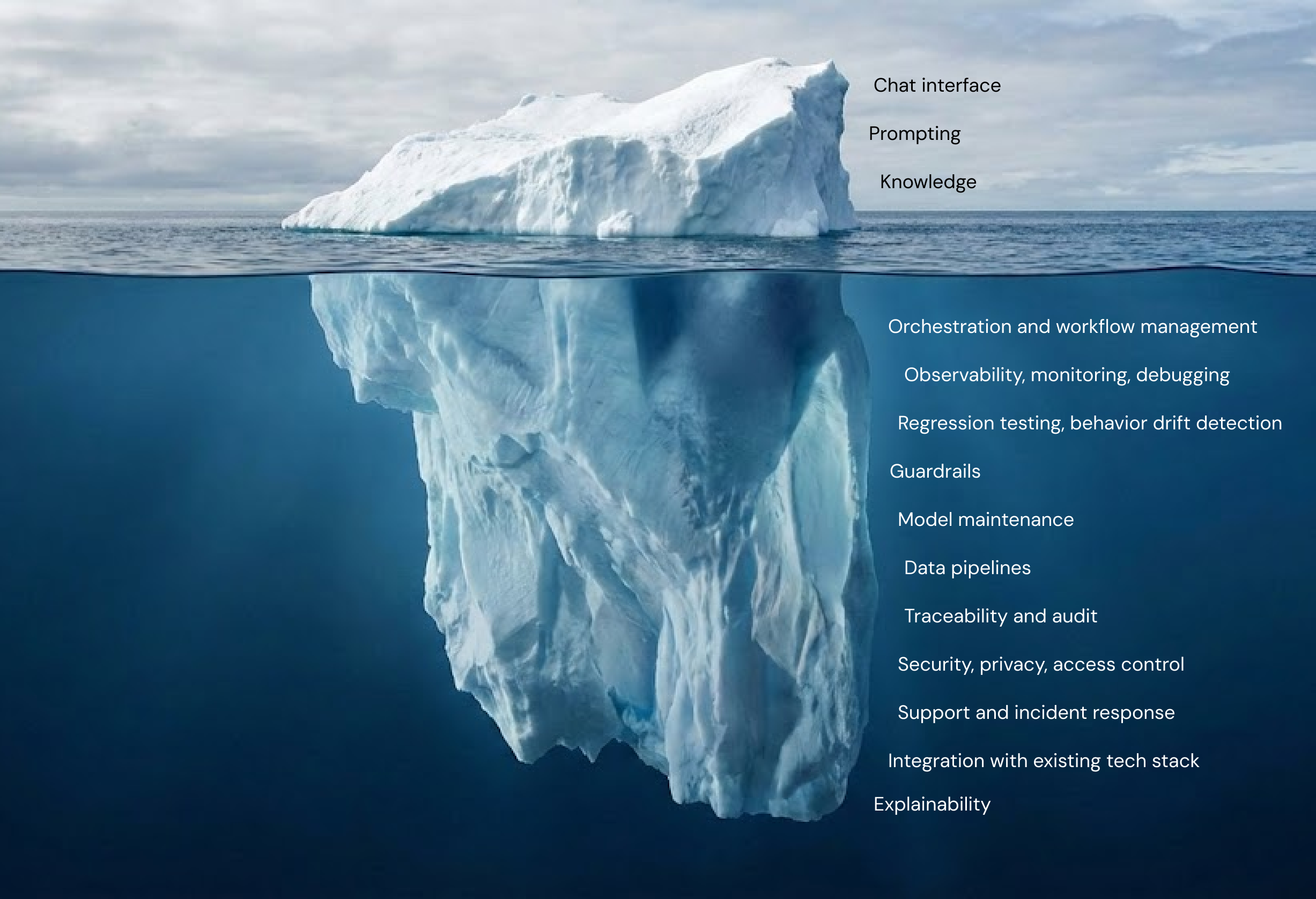
Once you look at the full picture, the true price of building in-house looks very different from the headline number in the original business case.
AI development is hard, because it’s so different from normal product development. Working with LLMs and agents is a fundamentally new discipline, which means for most companies without AI talent on board, the hurdles are insurmountable. And even for those that do, they might find that those resources are better allocated.
On top of that, the environment is evolving at a crazy pace - think about agent to agent workflows, MCP, and (soon) skills - all relatively recent developments. This pace means keeping your stack up to date is a constant struggle.
The advantages of buying from proven vendors
For the reasons listed above, only about 31% of finance teams plan to develop agents in-house - the majority choose not to.
Instead, they activate agentic AI through existing platforms, purchasing new software or working with external partners.
There's a reason for this preference. Vendor-built solutions offer ready-to-use capabilities, frequent updates, and embedded compliance controls that eliminate the need to build foundational infrastructure from scratch.
Think of it this way: AI agents must be developed, trained, and evaluated like employees. Imagine hiring a new team member without any prior experience or training, versus hiring an employee who is set to do the job from day one. Built correctly, vendor-built AI agents can integrate seamlessly with your existing systems, from ERPs and CRMs to data lakes and BI tools.
They can even integrate with existing applications like ChatGPT and Claude, safely bringing valuable context and real-time data into these interfaces.
For finance teams under pressure to deliver quick ROI, partnering with experienced vendors to leverage their expertise can raise the odds of success by 5% or more. Applying pre-vetted agentic AI solutions means faster time to value (deployed in weeks, not months or years), ongoing innovation (benefitting from continuous model improvements and best-practice benchmarks), and reduced risk (leveraging built-in data governance, explainability, and auditability).
The bottom line
According to Aditya Challapally, executing quickly with experienced AI vendors is one of the tenets of AI success, along with zooming in on a single business pain point and showing clear ROI.
Building your own agents - in most cases - goes against that ethos. It’s slow, difficult work that’s far harder to do well than it might appear.
The bottom line is that building in-house may sound strategic. But, for the vast majority of teams, buying means realizing value right now, rather than years down the line.
For those that do decide to build their own agents, I would offer one piece of advice: keep it as simple as possible. A single node agent, connected to a powerful tool like Pigment’s MCP server, can actually be quite powerful.