.webp)
Table of Contents
Key takeaways
- Large enterprise planning teams face shorter cycles, faster organizational change, and constant model adaptation, while modeling work remains a skilled, scarce, and expensive bottleneck.
- The Pigment Modeler Agent helps teams construct and refine custom business planning applications through natural language, while requiring human review and validation before changes occur.
- In a subscription-model transition, the agent proposes structured model changes for recurring revenue, churn, expansion, and cohorts without requiring a full rebuild.
- The workflow keeps traceability by recording what the Modeler Agent proposes, what users approve, and what the system executes.
- Customer results show major speed gains: Figma cuts hours to minutes, Docker reduces one to two days to one hour, and Carta shortens a week to about two days.
- Pigment constrains LLM risk through access-right enforcement, required human validation for meaningful changes, and model-context grounding instead of general web knowledge.
- The Modeler Agent follows a deep-agent design built on contextual knowledge, direct workspace tools, and structured skills for architecture, modeling, and use cases.


If you work in finance, HR, supply chain, or revenue operations in a large enterprise, you’re almost certainly feeling the squeeze: planning cycles are shorter, org structures shift faster, and the model behind your numbers has to constantly adapt.
The bottleneck is usually modeling work: structure, dimensions, calculations, views, governance, explanations, and the iteration loop after leadership feedback. It’s skilled, scarce, and expensive work.
Hiring more staff or reverting to manual spreadsheets aren’t scalable enough for modern business demands. As a result, critical projects often end up stalled in the backlog.
How the Modeler Agent helps
The Pigment Modeler Agent is the closest you can get to having a Pigment Solution Architect on staff 24/7.
It’s an extra teammate that helps you construct and refine custom business planning applications by simply asking in natural language.
The Modeler doesn’t replace your team. It requires your review and validation before it makes changes. But it does make your whole team more effective.
It targets a critical phase of enterprise planning: the stretch where ideas slow down as design complexity increases and struggle to translate into actionable models.
Let’s look at an example of how you might put it to use.
Example: Shifting sales strategy with the Modeler
Imagine you’re David, an FP&A Manager whose company is shifting from a one-shot sales model to a subscription-based business.
The existing model was simple: units × price. But that’s changing.
David tells the agent what he needs:
- "I need to move from revenue recognition at sale to recurring revenue with monthly and annual recurring revenue."
- "I want to model acquisition, expansion, churn, and cohort behavior over time."
- "I do not want to rebuild everything from scratch, just extend the model cleanly."
With Pigment Modeler Agent, the workflow looks like a guided build with a human solution consultant:
- The agent proposes structured changes aligned to the intent, explaining the reasoning behind its decisions
- David reviews the proposal and, for example, adjusts the churn logic to reflect different retention assumptions for enterprise vs SMB segments before validating the plan
- The Modeler applies changes, keeping a record of what was proposed, what was approved, and what executed, ensuring traceability
That’s just one example. There are plenty of other ways David could use the Modeler:
Modeling debt cleanup
Refactoring a legacy model that accumulated workarounds and structural shortcuts over time, without losing historical continuity.
Structural model extension
Adding driver-based rolling forecast capabilities to a model that was originally built for an annual budget and quarterly forecast.
And the feedback from customers has been extremely positive so far:
- Figma reported that work that used to take hours of designing, modeling, and framework building can now happen in minutes, improving how quickly ideas can be tested with stakeholders.
- Docker implemented a version dimension plan within an hour, a task they said would normally take one to two days of focused effort.
- Carta described a process moving from taking a week to about two days, crediting fewer cycles of trial-and-error, rework, and back-and-forth.
Guardrails and human-in-the-loop
The use of any LLM-driven functionality comes with implicit risks, owing to the non-deterministic nature of the technology.
That’s why guardrails are so important, and why we’ve invested significantly in building them into the Pigment platform:
- Permissions are respected: proposals must stay inside what users can do in Pigment, according to their Access Rights
- Human validation is required for meaningful changes, especially when stakes are high, like modifying a key calculation formula
- Hallucination risk is constrained by anchoring the agent in model context and rules, not general web and LLM knowledge
Knowledge, skills and tools
Many ‘AI’ features turn out to be a chat window glued to a product. Our design philosophy takes a fundamentally different approach, focused on building reliable, production-grade capabilities rather than superficial interactions. The Modeler Agent leverages a ‘deep agent’ design: structured expertise, scoped capabilities, and auditable behavior.
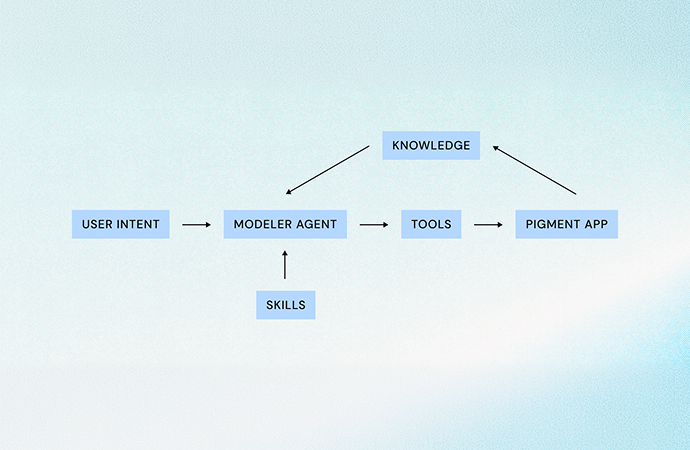
- Knowledge
Because it has access to all the relevant contextual data, the Modeler understands your application as if it were the Solution Architect who built it. - Tools
Tools allow the Modeler to directly interact with your Workspace - they’re what allows it to take action. - Skills
Skills are structured ‘knowledge packs’ that tell the Modeler what best practice looks like in Pigment. We have architecture skills, modeling skills, and use case skills
But if you want more information, you can ask the agent directly:
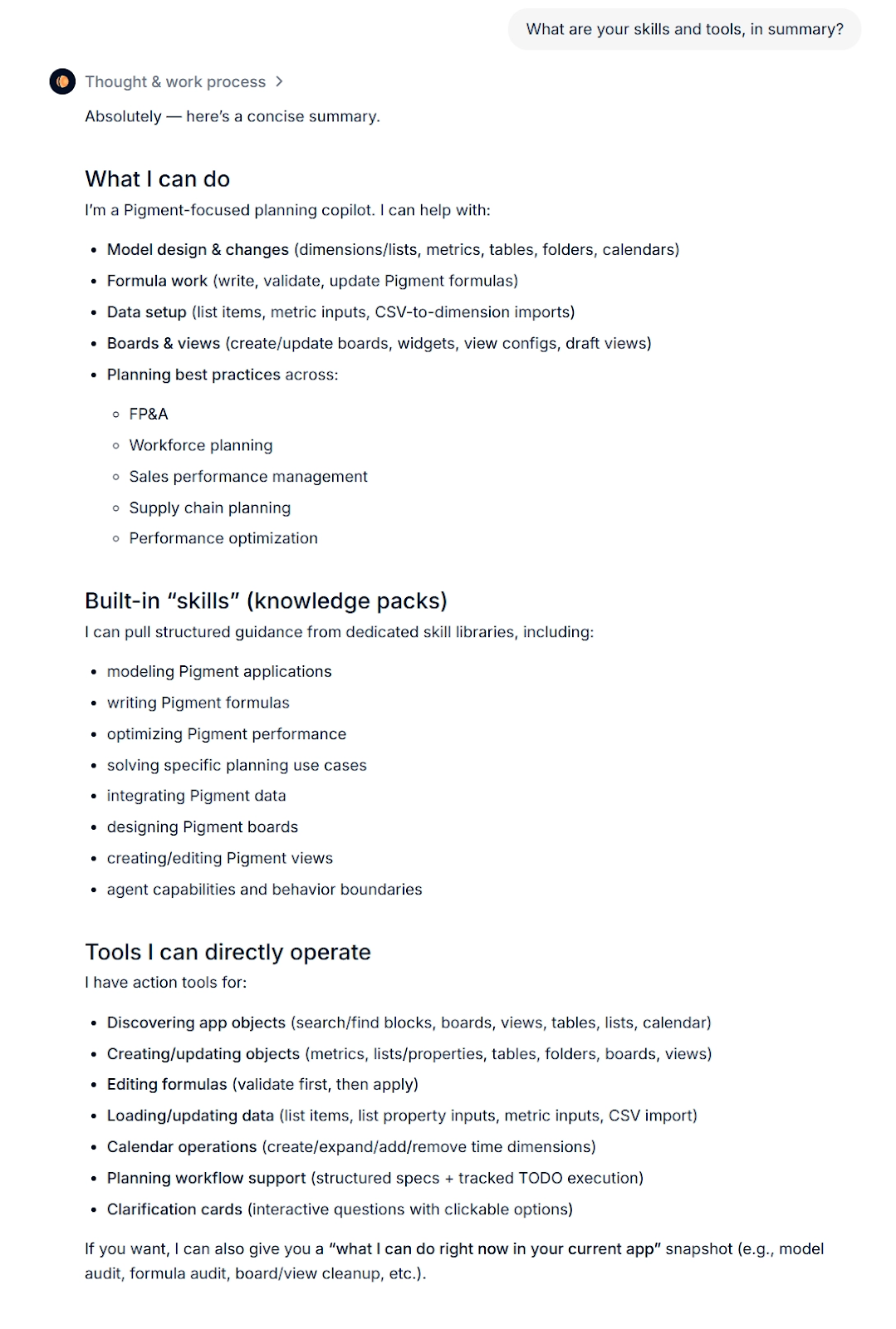
It’s for this reason that the Modeler can be so much more valuable for business users than general-purpose AI like Claude or ChatGPT.
It understands your business at a deep level, it’s trained specifically on planning best practice, and it’s able to leverage Pigment’s incredibly powerful calculation engine. And it does this while maintaining watertight security and governance.
Next steps
To see the Modeler in action, join the next live tour.
Frequently Asked Questions
What is the Modeler Agent?
The Modeler Agent is an AI agent in Pigment that helps you design, build, and evolve your planning applications. It understands Pigment best practices and assists you in creating or refining dimensions, metrics, formulas, views, and boards so your models stay robust, scalable, and business-ready.
How does the Modeler Agent work?
You describe what you want to achieve in natural language. The Modeler Agent analyzes your existing application and proposes a detailed, step‑by‑step plan. You review and approve that plan directly in Pigment, and only then does the Agent execute the agreed changes. Every step of the process is visible, explainable, and remains under your control.
What kind of work can it handle?
The Modeler Agent can help design new applications, set up and link dimensions and transaction lists, generate and refactor formulas, build input and reporting views, and prepare boards for end users. It can also assist with cleaning up and standardizing existing models.
Does the Modeler Agent replace modelers?
No. It’s built to augment, not replace, modelers and solution owners. The Agent handles repetitive, technical, and boilerplate tasks, like drafting structures, wiring formulas, or updating views, while human experts stay focused on business design, stakeholder alignment, validation, and governance. All key modeling decisions still come from you.
How does the Modeler Agent ensure accuracy and safety?
The Modeler Agent operates within Pigment’s governed environment and follows an assisted workflow. It respects existing access rights, relies on your live application structure, and applies Pigment modeling best practices. Before any change is applied, the proposed plan is surfaced for your review and explicit approval. After execution, changes are documented and can be managed through Pigment’s standard versioning and governance processes, ensuring your models remain consistent, explainable, and safe.