
Table of Contents
Key takeaways


Enterprise planning implementations haven’t changed in two decades. They all suffer from the same issues:
- Painfully gathered requirements locked into a document with no way of testing that they work, lots of menial work and ugly wireframes nobody really agreed to
- Reliance on a handful of consultants able to hand-translate each requirement into the system who then leave with their knowledge
- Reviewing functionality near the end of the process (however agile you try to be) - when fixing it is expensive
All of this amounts to a lengthy, expensive process that can lead to many organizations putting off a much-needed migration to a more mature platform. Legacy migration programmes typically run between 6 and 18 months.
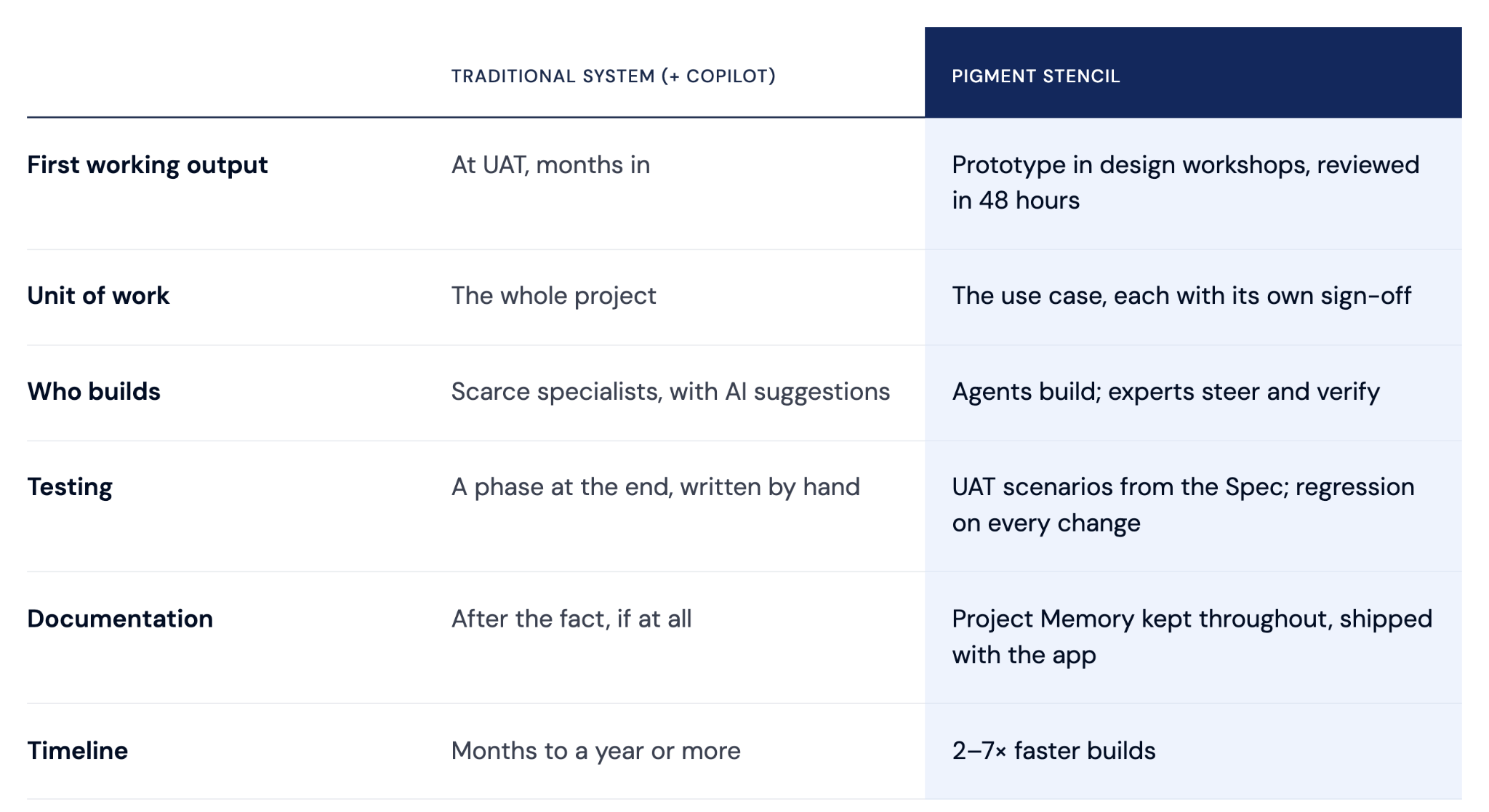
But today, we’re lifting the lid on the remedy: Stencil is Pigment’s new AI-driven delivery methodology that delivers projects 2-7 times faster when the right conditions are met.
How it works
Stencil assists you in every phase of the project, turns your requirements into a validated build spec, then builds, tests, documents the application in Pigment and leaves the project’s team knowledge with the run team.
You define the project
The business outcomes you’re looking for are documented after a series of design workshops. You validate prototypes.
Delivery experts weigh in
Pigment and partner specialists guide the architecture, review AI-generated logic, and sign off on quality.
Agents execute the plan
AI turns the requirements document into live Applications, then performs tests and produces documentation, working continuously alongside the team.
The team
Seven Stencil agents - running on Claude Code with Pigment skills - manage the project end-to-end under human supervision and improve over time. To learn more about their roles, read the technical deep dive we’ve published.
The Stencil is used along the Modeler Agent that runs inside Pigment, building Metrics, Formulas, and Boards directly in the customer Workspace, applying relevant best practices as it does so.
Success story: Avalara
Avalara is a leading cloud-based compliance software company, and recent Pigment convert.
Their implementation, one of the first using the Stencil methodology, took place over 16 weeks. The Modeler Agent handled around 90% of the initial build of a complex multi-product, multi-segment model.
In the course of their implementation, the Avalara team found that the delivery methodology gave them a real chance to rethink stale processes, rather than replicating them in a new platform.
“The team was clicking through an actual working model within days, which meant we caught structural issues — a driver that didn't reflect how a business leader actually thinks about capacity, a rollup that didn't match how our finance leadership reviews the P&L — while they were still cheap to fix.”
Raymond Yue, SVP of Finance, Avalara
Because of how much more tactile the process was, Raymond noted that buy-in from his team was significantly higher.
And the time they saved meant that Avalara was planning for its next fiscal year on Pigment, rather than running a legacy planning cycle in parallel - exactly the kind of double-cost scenario that puts some organizations off undergoing a migration.
“On ROI, I look at it as compressed cost avoidance plus compressed time-to-insight: the analyst hours we didn't spend maintaining spreadsheet workarounds, the planning cycles we didn't have to run twice, and the speed with which we could now answer a scenario question in the room instead of after a modeling exercise.”
Hear more about Avalara’s implementation →
How are we bringing Stencil to market?
Stencil agents will be released publicly on GitHub within the next month.
The technical details
Looking for a more technical breakdown? Read on below for technical details of each step of the Stencil process - from onboarding through to post-launch activity.