Table of Contents
Key takeaways


AI is already a significant line in any organization’s budget - and for most, it’s still growing.
Spend is notoriously difficult to predict - according to our figures, only 13% have stayed within their budget this quarter.
Model choice is the most powerful lever any organization can pull when managing their AI budget. On top of that, models move fast - new releases come a few times every month at this point, each coming with new benchmark scores and price per million tokens to evaluate.
We’ve been working with Fireworks AI to build a tool to help you out. Pick your use case and your budget, and it projects your AI spend over 3 years. It takes about a minute, and nothing you enter leaves the page.
Access the tool here →
Why now?
The AI spend simulator tool is part of a broader Pigment effort to assist organizations in managing their AI expenditure.
Earlier this year, we launched the AI Investment Planner, designed to help teams:
- See usage and cost data in one place, across providers, models, teams, projects, and use cases, then assign spend to the teams, cost centers, or initiatives that own it
- Forecast future spend based on historical usage numbers, adoption assumptions, model mix, and planned AI initiatives
- Calculate the ROI of AI initiatives by connecting spend to expected value
- Route new AI use cases through approval, from initial business case to executive sign-off, before spend commitments are made
How the spend simulator works
Pick your use case
Set your monthly budget
Anywhere from $100 to $200,000 a month. The planner then projects it over 3 years.
Read your plan
Your AI plan
The headline figure is your year-1 spend, followed by your 3-year total. Take $10,000 a month across 3 use cases, with usage growing 5% a month. That comes to $159,000 in year 1 and $958,000 over 3 years.
What your budget gets you breaks down each use case: monthly volume, model, monthly cost, share of budget, and year-1 total.
Your projected AI spend over 3 years
A stacked bar chart shows spend per plan year, by use case. Year 1 is your next 12 months.
The models you’re using today are highlighted on the left, with an optimized plan on the right. Hover over a bar to see each use case’s cost and model for that year, and how much less the optimized plan costs.
Optimized plan
For each use case, the planner pairs your closed model with an open model of the same tier on Fireworks, and shows the saving. Tier and volume stay the same.
In the 3-use-case example, the optimized plan costs $53,000 in year 1 instead of $159,000. Over 3 years, that’s $639,000 back in the budget.
This calculation is purely cost-based - it doesn’t take into account model performance, for example.
Test your assumptions
The Assumptions panel on the results page shows what happens when your usage changes.
Usage growth. Medium, the default, assumes usage grows 5% a month. Over 3 years, that multiplies your monthly spend by 5.8. Low and High sit either side of it.
You can also change your use case, model, and budget from the bar at the top of the results page, without starting over.
How the numbers work
Monthly spend starts at your budget and grows each month at the usage growth rate you choose. Year 1 is months 1 to 12, year 2 is months 13 to 24, and year 3 is months 25 to 36.
Volume is a use case’s monthly budget share divided by the cost of one unit of work. That cost is the use case’s typical input and output tokens multiplied by the model’s per-token price.
The optimized cost keeps each use case’s volume and tier, and prices it at the matched open model’s per-token price.
Prices are public list prices per million input and output tokens at the time of publication. They don’t include volume discounts, committed-use pricing, caching, batch pricing, or the cost of switching providers.
The planner matches models by tier, which reflects compute and typical task quality. Run your own evaluations before you move a production workload. The figures are estimates for planning, not a quote.
Try it for yourself
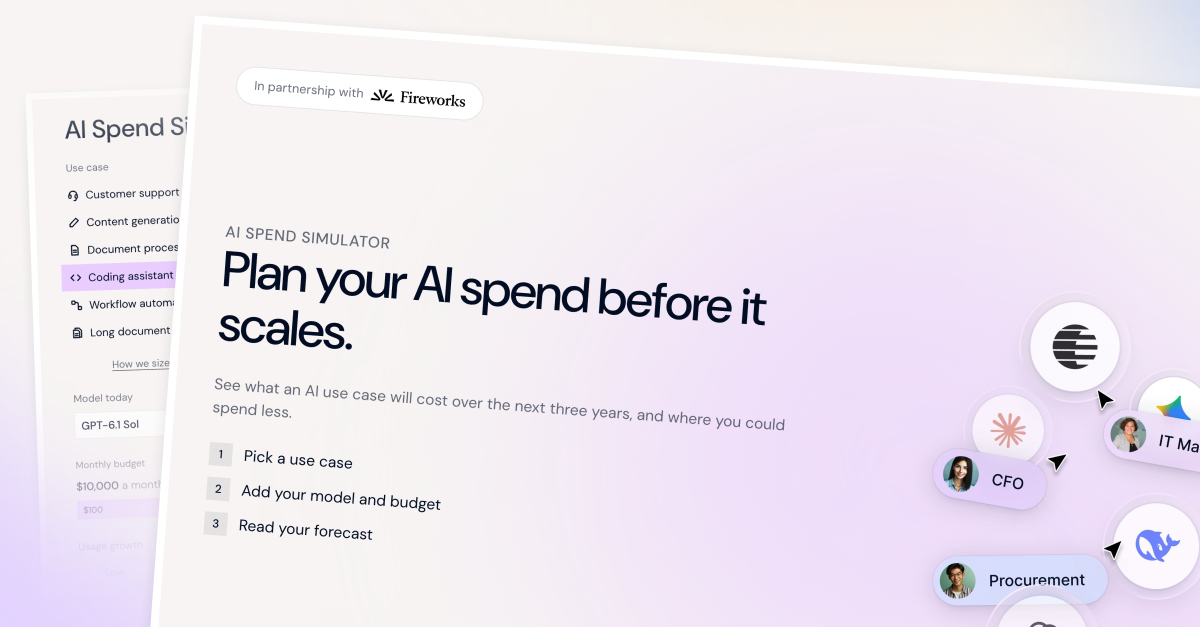
Access the tool here →
Frequently Asked Questions
Why do open models generally cost less?
Open models like GPT-OSS, GLM, and Kimi don’t carry a closed provider’s model margin. Fireworks serves them on an inference engine tuned for speed and cost, and passes the difference on in its per-token prices.
Will I get the same quality?
The planner matches by tier, not by benchmark score. For high-volume Efficient and Balanced work, such as support conversations and variance commentary, open models are often a strong fit. For complex Frontier reasoning, a closed model may still be worth paying for. Test against your own data before you switch.
Do I have to switch everything?
No. The planner matches each use case on its own. Many teams move their high-volume use cases first and keep a closed model where it matters most.