.webp)
Table of Contents
Key takeaways
- Pigment MCP Server combines AI speed with planning governance by grounding Claude in live Pigment metrics, hierarchies, and models while respecting permissions.
- At Level 1, Claude answers with governed access to actual Pigment numbers, avoiding stale exports or guessed results.
- At Level 2, Cowork connects to Pigment through MCP as a custom frontend where every forecast entry remains traceable, auditable, and tied to one source of truth.
- At Level 3, Claude Code changes existing Pigment applications or builds new ones, while Pigment’s Modeler Agent already speeds model building inside the platform.
- The Pigment Harness standardizes implementations through one versioned repository of skills, eight specialized agents, and project templates and commands.
- The build process spans six phases plus two continuous agents, with an anchor number set in design and human sign-off required before anything ships.
- Pigment reports early results that cut workflows previously taking weeks down to as little as one week without sacrificing accuracy, permissions, or traceability.


Like everyone right now, our team is figuring out how to work in a world where AI changes what's possible week to week. It’s tempting to focus on speed, but that isn’t the whole game in planning. Generating a model in minutes means nothing if you can't trust the numbers or trace where they came from.
So we've been working on a way to get both: the speed AI makes possible, and the governance that planning actually requires. Pigment's MCP Server sits at the center of it. What follows is our current thinking, and a framework we're seeing real early results with.
One principle we keep coming back to is that people should be able to work however they want, in whatever tool fits the job. The three levels below are less a product roadmap and more a map of where MCP can take you, from asking better questions to building entire applications.
“Pigment is showing what's possible when AI becomes a partner in strategic planning. As both a technology partner and a Pigment customer, we're seeing firsthand how their approach of connecting planning data directly to Claude through their MCP Server lets teams focus on strategic decisions rather than data wrangling.”
Guillaume Princen, Head of EMEA, Startups, Digital Natives, and Mid Market, Anthropic
Level 1: Claude + Pigment MCP
Start here.
MCP makes Pigment’s data and logic available to Claude in whatever form you’re using. Claude gets governed access to your live metrics, hierarchies, and models, with your permissions respected at every step. The answers you get back are grounded in your actual numbers, not a stale export or a guess.
Level 2: Using Cowork as a frontend for Pigment
Connect a live artifact in Cowork to Pigment through MCP and you get a custom frontend on top of your planning data. Submit a forecast from an interface built for the job, without losing what makes Pigment unique: every entry stays traceable, auditable, and tied to a single source of truth.
The flexibility of a bespoke tool, with the discipline of a planning platform.
Level 3: Application build and enhancement with Claude Code
While the Modeler Agent already speeds up model building inside Pigment, you can also drive Claude Code from the command line to change an existing Pigment application, or build a brand new one from scratch.
Each of those tools is powerful on its own. To deliver a whole Pigment engagement, we bring the full set of Claude products together into one system. We call it the Pigment Harness.
The Pigment Harness
The Pigment Harness is a shared starting point for every Pigment implementation our team runs. Skills, agents, templates, and commands, all versioned in one repository, cloned at the start of every project, and improved after every engagement. It means faster delivery and consistent quality, and because we feed the lessons back in each time, it compounds.
Here's what's included:
- Skills
Versioned know-how from past projects: modeling, formulas, performance, access rights, board design, all packaged for Claude to apply on demand. - Agents
Eight specialists, each scoped to one part of the build. Six map to a specific phase, two run throughout. - Templates and commands
Project scaffolding for memory, decisions, and roadmap, plus the commands that kick off every engagement.
A Pigment Solution Architect runs the engagement end to end: scoping, operating Claude Code, reviewing every change, owning the customer relationship.
Claude Code orchestrates the agents from the harness, running each against the versioned skills and patterns we've proven on past builds.
And the Pigment MCP Server sits underneath it all, authenticating every call and enforcing workspace permissions server-side.
The team of agents looks like this:
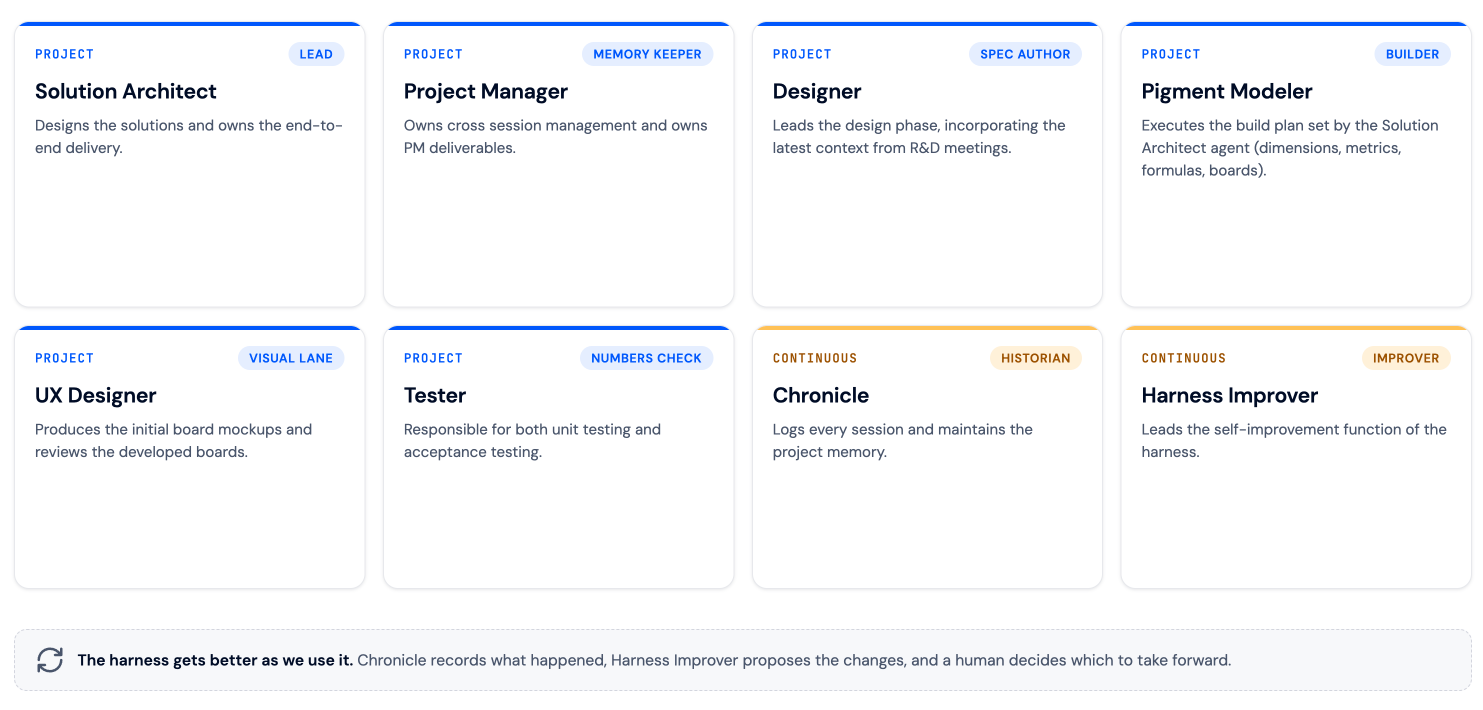
The build runs across six phases, with two agents working continuously alongside them.
Early on, the design phase fixes an "anchor number," a single agreed target the whole build is measured against, so the model can't quietly drift away from what we set out to deliver.
- Phase 01 - Onboarding
Scaffold the project, mobilize the team, and align on scope. - Phase 02 - Design
Design doc, acceptance criteria, the architecture and mockups. - Phase 03 - Build
Use case by use case, with automated validations at each step. - Phase 04 - Test
Verified against the mockups and acceptance criteria. - Phase 05 - Launch
The app deployed for production use. - Sustain (continuous)
Every session logged, with Harness improvements proposed for human approval.
The throughline across all of it: a human reviews every change, the anchor keeps the build honest, and nothing ships without sign-off.
The bottom line
That’s where we've landed to date, and we're producing quality results in dramatically shorter timeframes. The workflow above would have taken weeks of work before AI - we're now doing it in as little as one.
Speed gets the headlines, but the part we're proud of is that we haven't traded anything away to get it. The numbers are still right, permissions remain in place, and you can still trace every figure back to its source.
To learn more about MCP, AI, and Pigment, request a demo from a member of our (human) team.